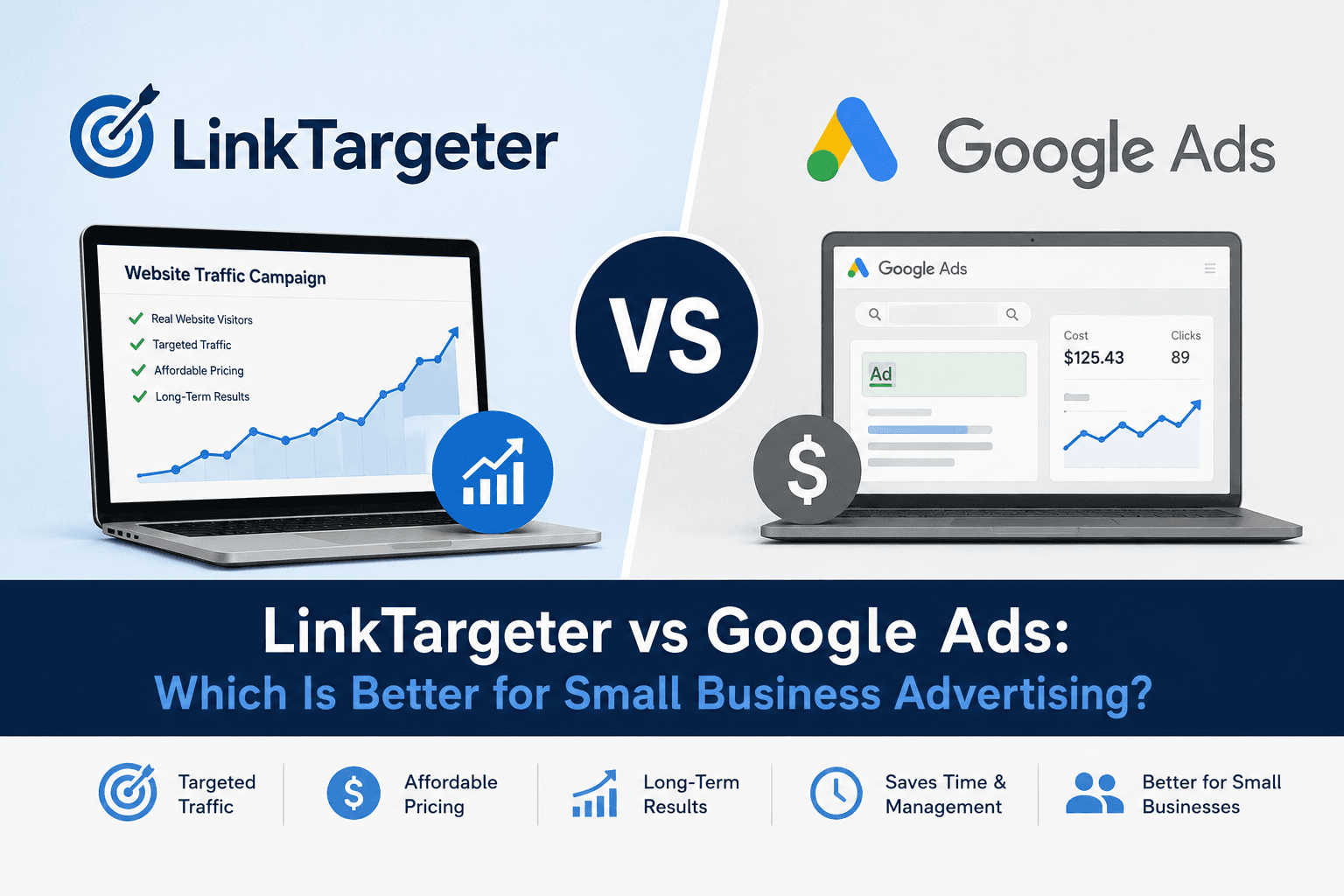
Choosing the wrong advertising platform can quickly drain your marketing budget before you land your first customer. If you are comparing LinkTargeter vs Google Ads, you need to know how to balance upfront costs, setup complexity, and traffic conversion speeds.
This side-by-side comparison breaks down the exact costs, ease of use, and traffic performance of both platforms to help small business owners make the right investment.
Quick Summary Matrix
LinkTargeter: Best for small businesses and startups looking to buy targeted website traffic. It is a plug-and-play platform with a predictable pricing model that takes under 10 minutes to set up.
Google Ads: Best for scaled budgets and high-intent search queries. It is an advanced platform with a steep learning curve that uses variable pay-per-click (PPC) bidding and requires hours of keyword research to configure.
The Core Differences Explained
What Is Google Ads?
Google Ads is an auction-based pay-per-click (PPC) network. You select specific search phrases, bid against competitors, and pay a shifting fee every time a user clicks on your link.
The Advantage: It places your business at the absolute top of Google search results right when a customer is looking to buy.
The Disadvantage: Highly competitive keywords can cost tens of dollars per single click. If your website doesn’t convert that visitor instantly, your daily budget can vanish in minutes.
What Is LinkTargeter?
LinkTargeter is a streamlined website promotion platform built as a cost-effective alternative to standard PPC networks. Instead of forcing you into complex, high-stakes keyword auctions, it focuses on delivering consistent, predictable website visibility.
The Advantage: It removes the stress of shifting cost-per-click tracking, quality scores, and daily budget exhaustion.
The Disadvantage: It is not a pure search-engine intent platform, meaning it works best when paired with an active content marketing strategy.
Head-to-Head Performance Breakdown
1. Cost and Budget Predictability
The absolute biggest divider between these platforms is how they bill your business.
With Google Ads, your costs fluctuate constantly based on what your competitors are spending. In competitive industries, your ad spend can spiral out of control without guaranteeing a single sale.
Conversely, LinkTargeter prioritizes budget-friendly advertising solutions. It gives small business operators an accessible entry point with predictable pricing, removing the risk of unexpected bill spikes when you need to get cheap advertising that drives website sales.
2. Campaign Setup and Management
Google Ads demands significant technical management. To run a successful campaign, you must master keyword match types, negative keyword exclusions, conversion tracking tags, and ongoing bid optimization.
LinkTargeter eliminates this steep learning curve entirely. The user interface is designed for straightforward campaign deployment, allowing entrepreneurs to promote their sites without hiring an expensive agency.
Which Platform Fits Your Business Type?
Different business models require different traffic strategies. Here is how to align these platforms with your specific business structure:
Local Service Providers (Plumbers, Lawyers, Roofers)
If you operate a local business where customers need help immediately, Google Ads is highly effective. When a pipe bursts, a homeowner searches “plumber near me” and clicks the top link. They are ready to hire on the spot, making the high cost-per-click worth the investment.
Content Sites, E-commerce, and Agencies
If you run an online store, a content site, or an agency looking for broad brand visibility, LinkTargeter offers superior value. It allows you to drive consistent traffic to your landing pages and content funnels without bleeding your marketing budget dry on competitive keywords. For a detailed look at display network comparisons, check out our guide on LinkTargeter vs BuySellAds.
Real-World Budget Breakdown
To visualize how your money moves on each platform, let’s look at a typical $500 monthly marketing budget:
On Google Ads: If your industry’s average cost-per-click is $5.00, your $500 budget will buy you exactly 100 visitors for the entire month. Once those 100 people click, your ads turn off completely until the next billing cycle.
On LinkTargeter: Because it bypasses the competitive auction model, a budget-friendly platform like LinkTargeter allows you to stretch that exact same budget to secure a steady, continuous stream of baseline website visitors without a strict click-cutoff.
The Verdict: Which Platform Should You Choose?
Choose Google Ads If:
You have a large, flexible marketing budget.
You need immediate search engine real estate for high-intent buyer keywords.
You have the time or staff to monitor and tweak ad campaigns daily.
Choose LinkTargeter If:
You want an affordable, predictable way to drive consistent traffic.
You want a fast setup without navigating complex digital marketing tools.
You need to protect your baseline budget while building your online presence.
- Use our free UTM tracking tool
Pro-Tip for Maximum Traffic: The most successful digital marketing strategies do not rely on a single channel. Many growth-focused brands use both tools simultaneously—capturing direct search intent via Google Ads while maintaining steady, affordable baseline visibility through LinkTargeter.
Frequently Asked Questions
Is LinkTargeter easier to use than Google Ads?
Yes. LinkTargeter bypasses complex bidding strategies and intensive keyword research, making it much simpler for solo business owners to navigate.
Why do Google Ads costs fluctuate?
Google Ads runs on a live auction framework. As more competitors bid on the same keywords in your industry, the cost-per-click rises automatically.
Can I run campaigns on both platforms at the same time?
Absolute. Combining platforms diversifies your traffic ecosystem and ensures your website traffic doesn’t drop if one platform changes its algorithm or pricing.